
A peptide can arrive with excellent purity and still underperform if storage conditions are careless. That is why knowing how to store research peptides matters just as much as choosing a reliable source. Temperature swings, moisture exposure, repeated handling, and poor reconstitution practices can all reduce stability and compromise research consistency.
For research buyers, storage is not a housekeeping detail. It is part of quality control. If a vial is exposed to heat during routine handling, left in a bright workspace, or repeatedly thawed and refrozen, you introduce avoidable variables into your workflow. In peptide research, those variables can affect repeatability, interpretation, and confidence in the material itself.
The correct storage method depends on one basic question: is the peptide lyophilized, or has it already been reconstituted? Those two states behave differently, and the wrong assumption can shorten usable life quickly.
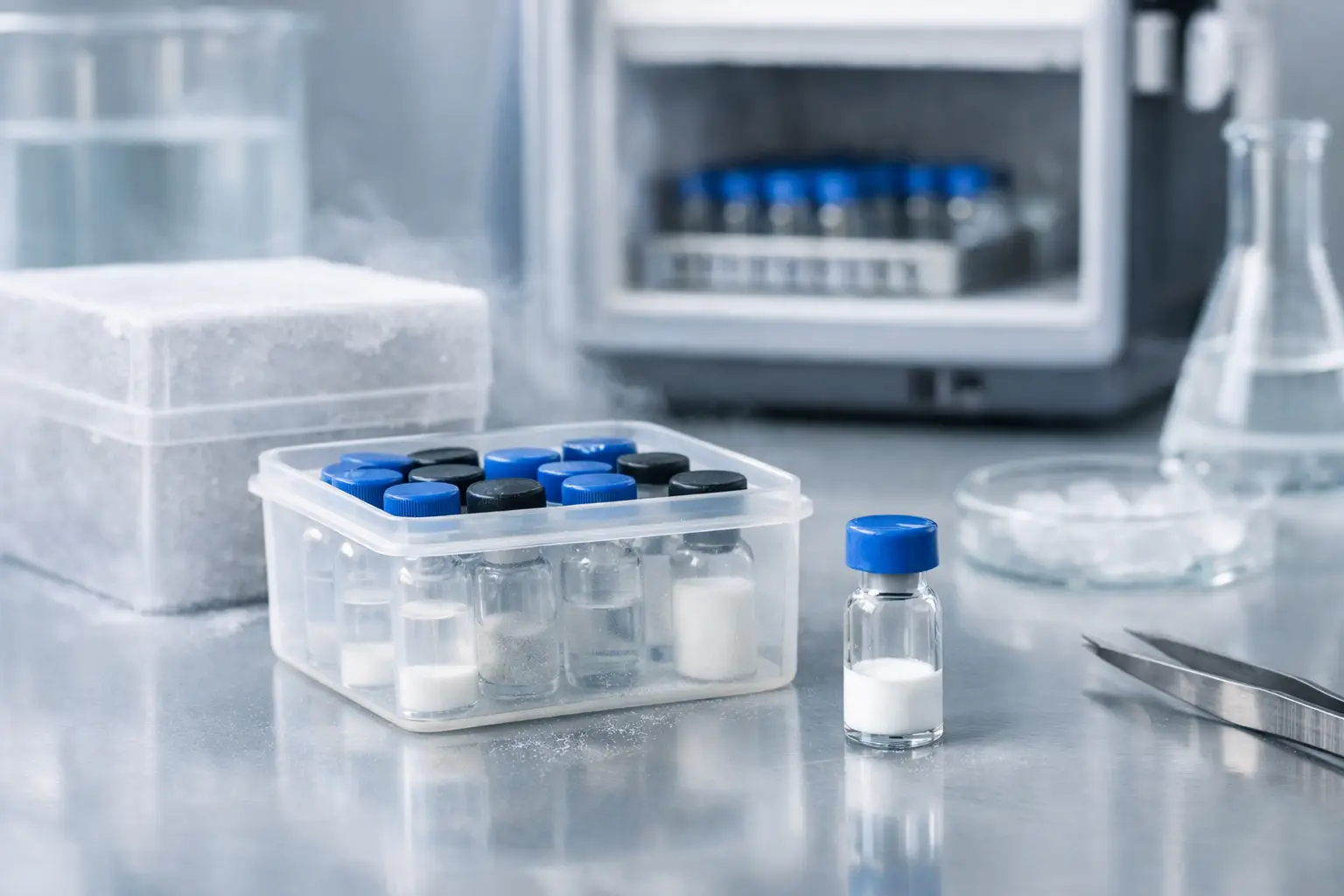
Lyophilized peptides are generally more stable than liquid preparations. In most research settings, they should be kept tightly sealed, protected from light, and stored at low temperatures. For shorter holding periods, refrigeration may be acceptable depending on the compound and packaging. For longer-term storage, freezing is usually preferred because it slows degradation and limits environmental stress.
Once a peptide has been reconstituted, stability usually drops. Water creates the conditions for hydrolysis, microbial risk increases if handling is not controlled, and temperature sensitivity becomes more relevant. In practical terms, reconstituted material should typically be kept refrigerated for near-term use or frozen in aliquots if longer retention is necessary.
The trade-off is straightforward. Lower temperatures generally support longer storage life, but frequent movement between freezer, bench, and refrigerator can create its own problems. A well-planned storage routine is better than simply choosing the coldest available setting.
Temperature has the largest effect on peptide preservation. Heat accelerates degradation pathways, while stable cold storage helps maintain structural integrity. For that reason, peptides should never be stored near windows, in vehicles, close to lab equipment that generates heat, or in any area with fluctuating ambient conditions.
For lyophilized vials, refrigeration may be suitable for short durations if the peptide will be used in the near term and the vial remains unopened. For extended storage, freezer conditions are typically more appropriate. Many research operations use standard freezer storage for inventory intended to remain stable over a longer window.
For reconstituted peptides, refrigeration is often used for active short-term handling, while freezing is better for aliquoted stock that will not be accessed daily. What matters most is consistency. A stable refrigerator at the correct range is more reliable than a freezer that experiences frequent warming from repeated door openings or poor organization.
If you are holding multiple compounds, avoid treating all peptides as interchangeable. Sequence, formulation, and intended storage duration can affect the best approach. Vendor-specific handling guidance should always take priority when available.
Repeated freeze-thaw cycles can be hard on peptide material, particularly once reconstituted. Every thaw introduces a period of instability, and every refreeze adds stress that may affect quality over time. This is one of the most common preventable mistakes in peptide handling.
The better practice is to divide reconstituted material into smaller aliquots before long-term freezing. That allows each portion to be thawed once and used as needed, rather than exposing the full volume repeatedly. It also improves process control by reducing contamination risk from frequent vial access.
Aliquoting takes more planning up front, but it usually protects consistency later. For labs and repeat buyers focused on dependable experimental inputs, that small operational step makes a measurable difference.
Peptides are not only sensitive to temperature. Moisture, oxygen, and light exposure can also influence stability, especially during storage after a vial has been opened.
Lyophilized peptides should remain sealed until use. Opening a vial unnecessarily allows humidity from the environment to enter, and that exposure can start degrading material before reconstitution even occurs. If a vial is removed from cold storage, allow it to reach room temperature before opening. This helps reduce condensation forming inside the container.
Light protection is another practical safeguard. Opaque packaging, secondary containers, or dark storage environments can help reduce photo-related degradation for sensitive compounds. Even when light sensitivity is not extreme, minimizing exposure is still good handling practice.
Air exposure should also be limited. Every time a vial is opened, the material is exposed to atmospheric moisture and oxygen. That does not mean occasional access is automatically harmful, but repeated unnecessary handling increases avoidable risk. Efficient workflow and clean technique preserve more than convenience. They preserve material quality.
The moment a peptide is reconstituted, storage becomes more time-sensitive. Liquid preparations are typically less stable than lyophilized forms, and the solvent choice can influence that stability further.
Use only appropriate laboratory handling procedures and suitable diluents for your research context. Once reconstituted, label the vial clearly with the compound name, concentration, diluent, date of reconstitution, and any internal tracking reference. In a controlled research setting, incomplete labeling creates preventable uncertainty.
If the material will be used over a short period, refrigeration may be sufficient. If it will be retained longer, aliquot and freeze instead of repeatedly accessing one master vial. This is especially relevant for buyers managing premium peptide inventory where batch consistency and reduced waste have direct operational value.
There is no universal shelf-life answer that applies to every peptide in liquid form. Some compounds are more stable than others, and storage performance depends on concentration, solvent, sterility, and handling discipline. The safest approach is conservative planning: reconstitute only what you need, when you need it.
A reliable storage setup does not need to be elaborate, but it does need to be disciplined. Use containers that remain tightly closed, keep labels legible, and separate peptide inventory from materials that could create confusion or contamination risk. Secondary sealed storage can provide an extra layer of protection against moisture and incidental exposure.
Organization also affects stability. If researchers need to search through a crowded freezer for one vial, door-open time increases and temperature control suffers. Inventory should be arranged so access is quick, labels are visible, and older stock can be identified easily.
In practice, the best storage systems are simple enough to follow consistently. Premium materials deserve handling standards that match their intended research value.
The most common errors are avoidable: storing peptides at room temperature for too long, opening cold vials before they equilibrate, exposing material to repeated freeze-thaw cycles, using unclear labels, and reconstituting more volume than the workflow actually requires.
Another issue is assuming shipping conditions and storage conditions are the same thing. A product may arrive in acceptable condition, but long-term stability still depends on what happens after delivery. Procurement quality and post-receipt handling are part of the same chain of control.
When buyers focus on purity, batch reliability, and formulation standards, storage should be viewed as the final layer of protection. Even a well-manufactured peptide can lose practical value if it is handled casually after receipt. Precision is not only about what was produced. It is also about what is preserved.
This is especially relevant for research-focused procurement, where consistent inputs support cleaner comparisons and better internal confidence. Proper storage reduces preventable variability, protects inventory investment, and supports more dependable use across the life of the material.
For serious peptide research, best practices are straightforward: keep lyophilized material cold, dry, sealed, and protected from light; treat reconstituted peptides as more fragile; minimize freeze-thaw cycles; and label everything with precision. Peptide Haven serves a market that expects consistency, and storage discipline is one of the clearest ways to protect it after the vial is in your hands.
The simplest rule is often the one that holds up best – store with intention before you need the peptide, not after a problem appears.